‘Cabinets of Heartbreak’ Student-Led Project
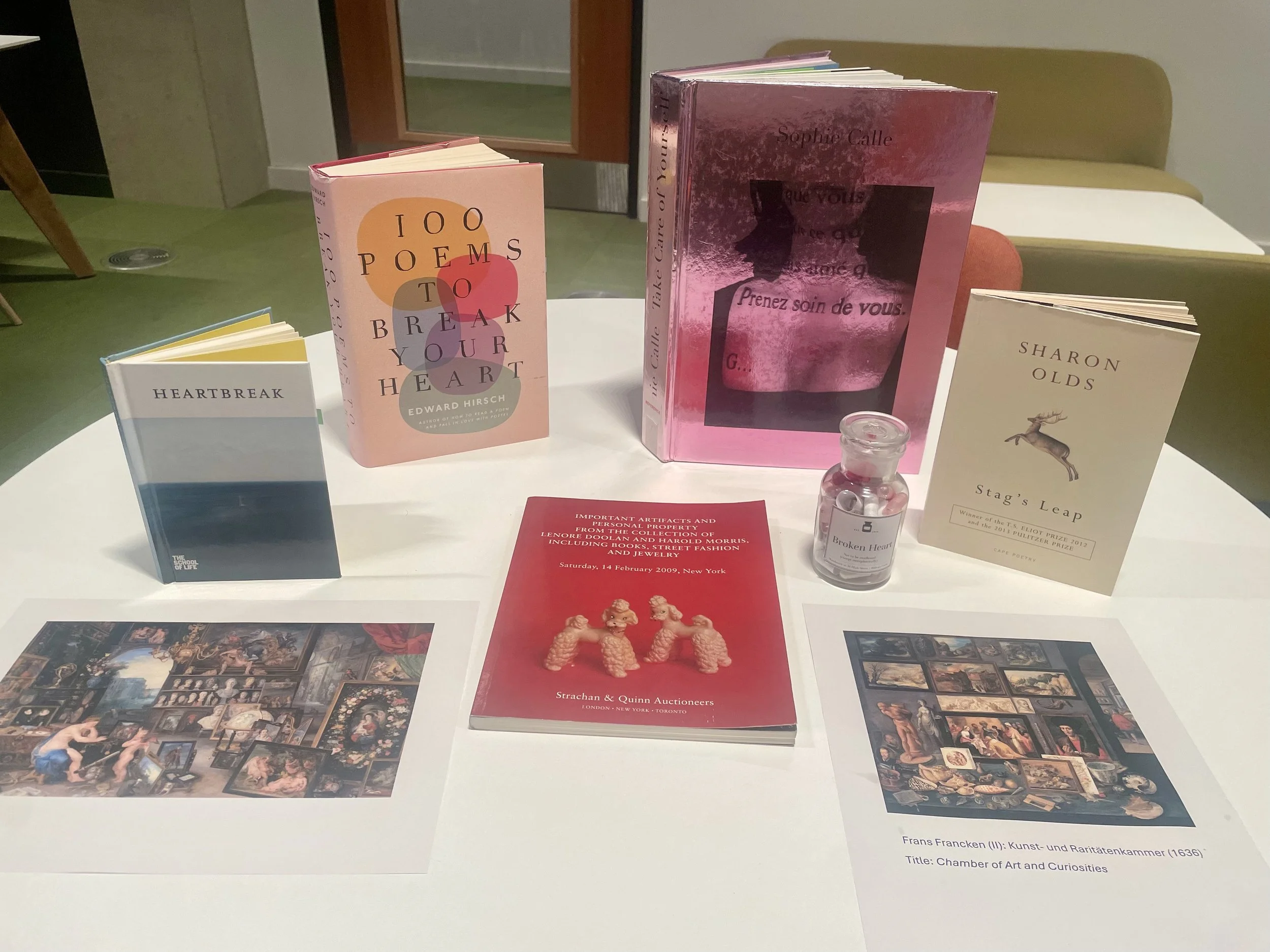
The ‘Cabinets of Curiosity’ project is a student-led initiative which takes place every year between November and February at Warwick, in which undergraduate students design themed cabinets on historical subjects to display around the History department.
The term ‘Cabinet of Curiosity’ comes from the German Wunderkammer (‘Chamber of Marvels’), coined in c. 1550, with cabinets typically displaying interesting, exotic, and unusual objects designed to amaze and awe spectators. These included items such as paintings and sketches, religious relics, scientific instruments, precious jewels, curios such as ‘unicorn horns’ and ‘mermaids’, taxidermy animals, and natural history objects such as shells, fossils and feathers.
By 1594, the philosopher Francis Bacon could avow in his Gesta Grayorum that any learned gentleman should have a ‘goodly, huge cabinet, wherein whatsoever the hand of man by exquisite art or engine has made rare in stuff, form or motion; whatsoever singularity, chance and the shuffle of things hath produced; whatsoever Nature has wrought in things that want life and may be kept; shall be sorted and included’ .[1] These early cabinets had ‘a somewhat disordered approach to order’, as Freya Gowrley puts it, displaying objects and materials from different regions simultaneously.[2]
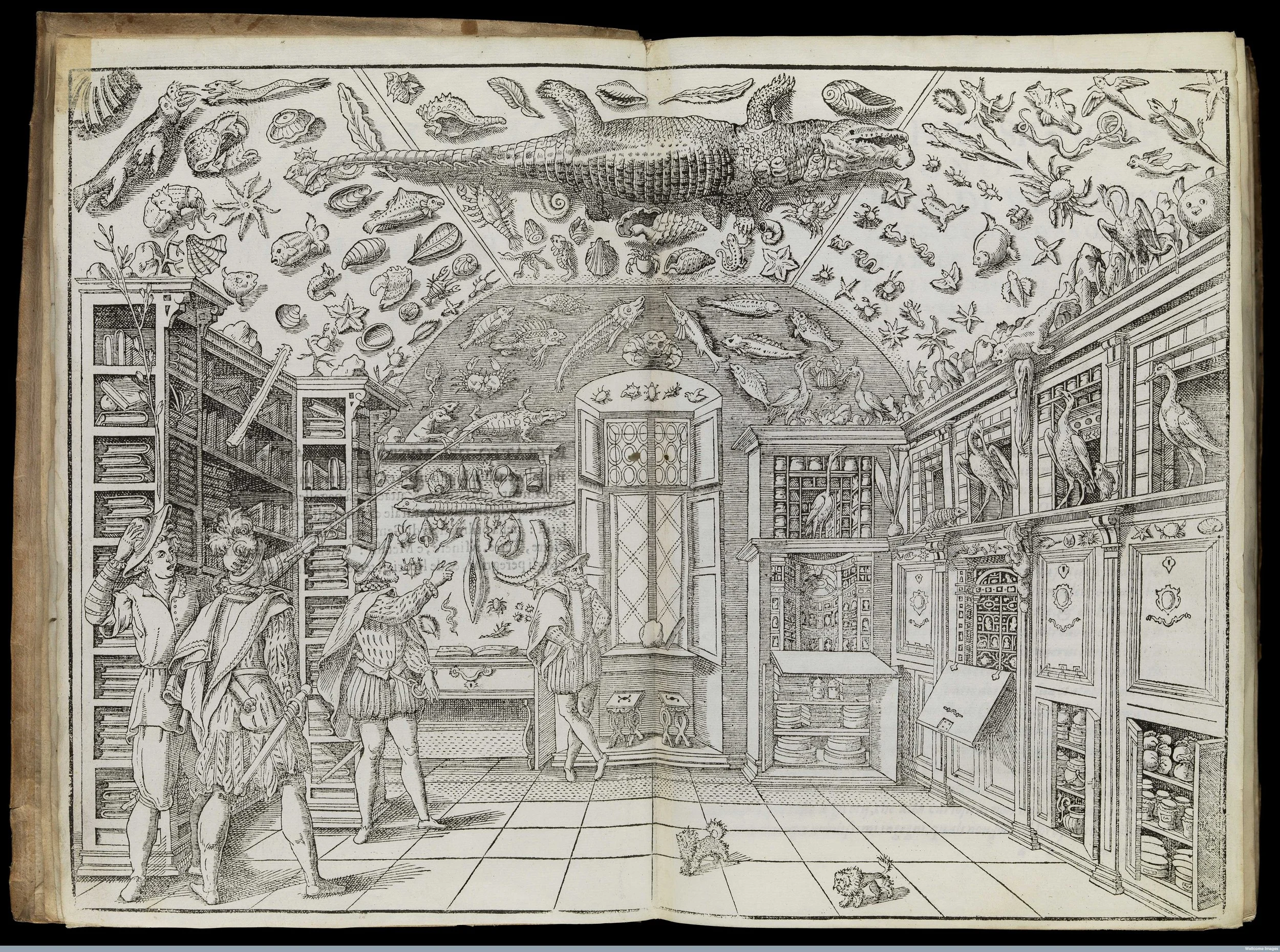
The earliest illustration of a ‘Cabinet of Curiosity’ - the frontispiece to the Neapolitan apothecary Ferrante Imperato’s book on natural history from 1599, featuring an alligator on the ceiling, taxidermy birds standing on the shelves, and curios such as dogs and pigs with two heads, and lizards and snakes with two bodies (see if you can spot them!) Image: Wellcome Library, CC BY 4.0.
The practice continued in popularity over the seventeenth and eighteenth centuries, spreading from princes to learned gentlemen and the middle classes as a means of showcasing their learning, status, and influence. In turn, cabinets became less random in their design, and more systematic in how they sorted things into groups. They increasingly featured separate areas for scientific instruments, artworks, paintings, sculptures, and natural history objects, reflecting the Enlightenment’s drive to categorise and classify the world. These ‘multiple parts transformed into a contained whole’, bespeaking the cultural capital of their owners and their mastery over the world around them.[3]
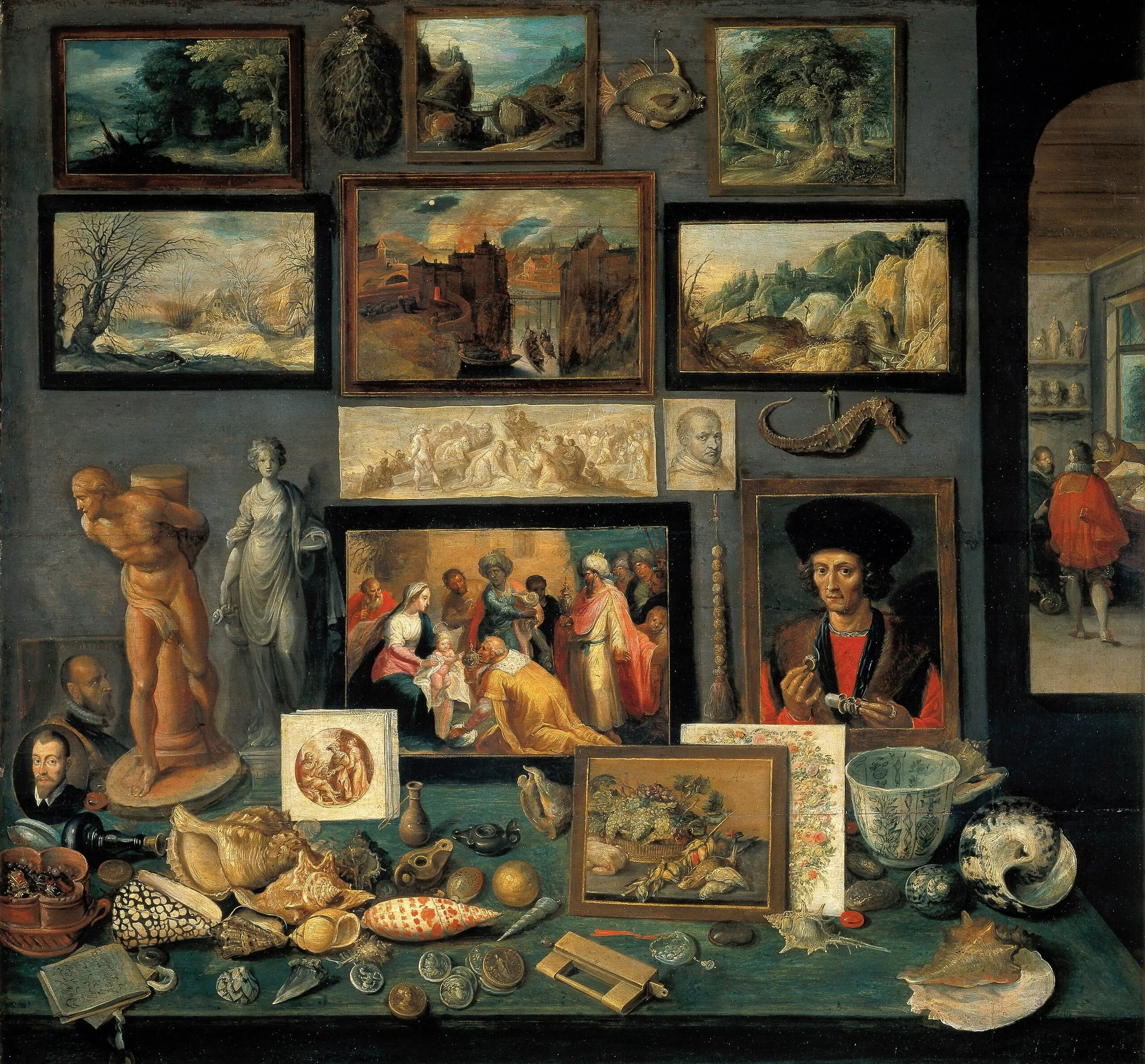
Frans Francken the Younger, Cabinet of Curiosities, 1636, oil on panel, Kunsthistorisches Museum, Vienna, Public Domain.
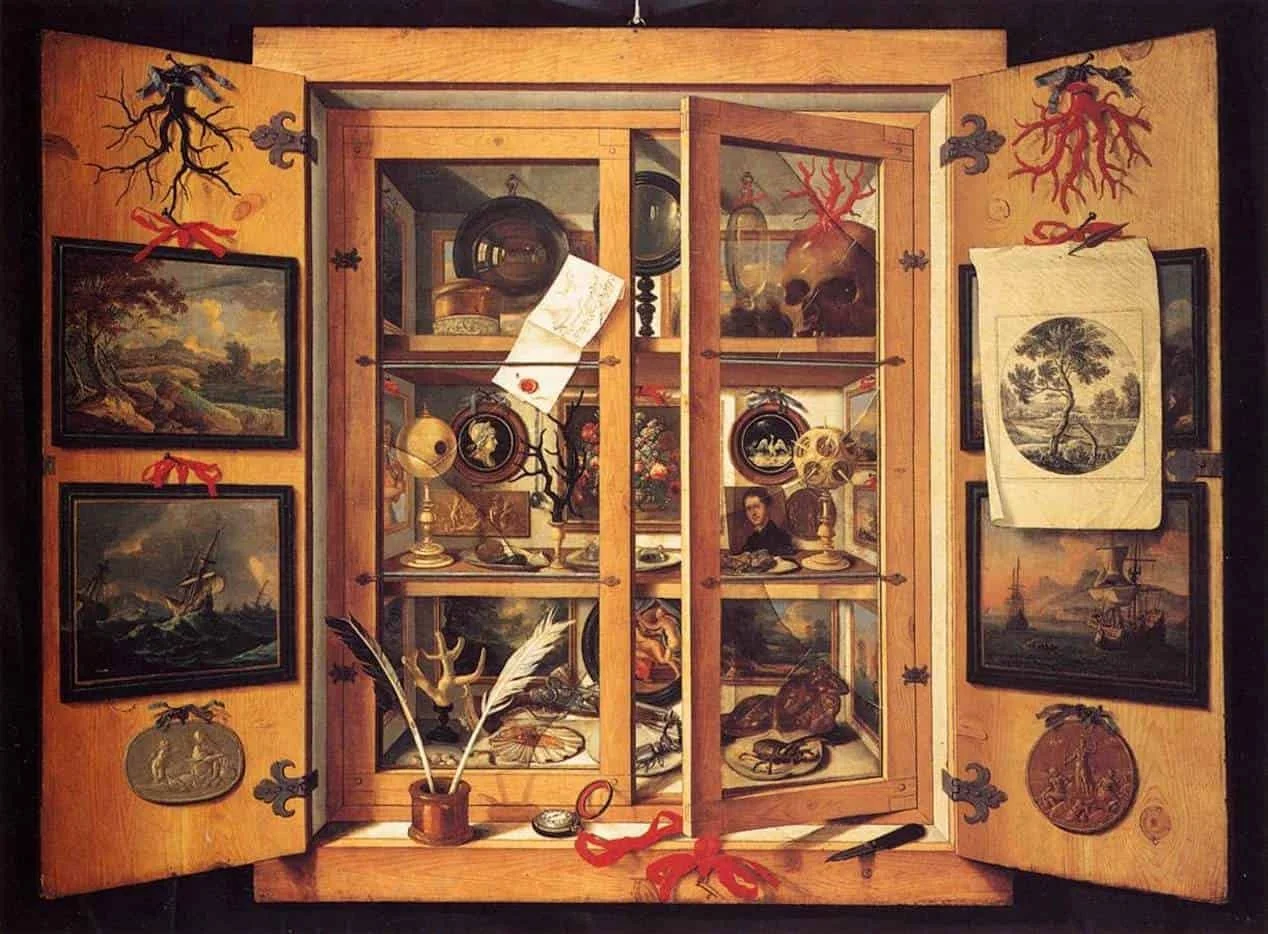
Domenico Remps, Cabinet of Curiosities, 1690, oil on canvas, Museo dell’Opificio delle Pietre Dure, Florence, Public Domain.
In 2025/6, ‘Cabinets of Curiosity’ participants will be designing cabinets on the theme of romantic heartbreak as part of the After Love project. One of their key tasks will be deciding how to present the story of heartbreak using an assemblage of text, images, and objects.
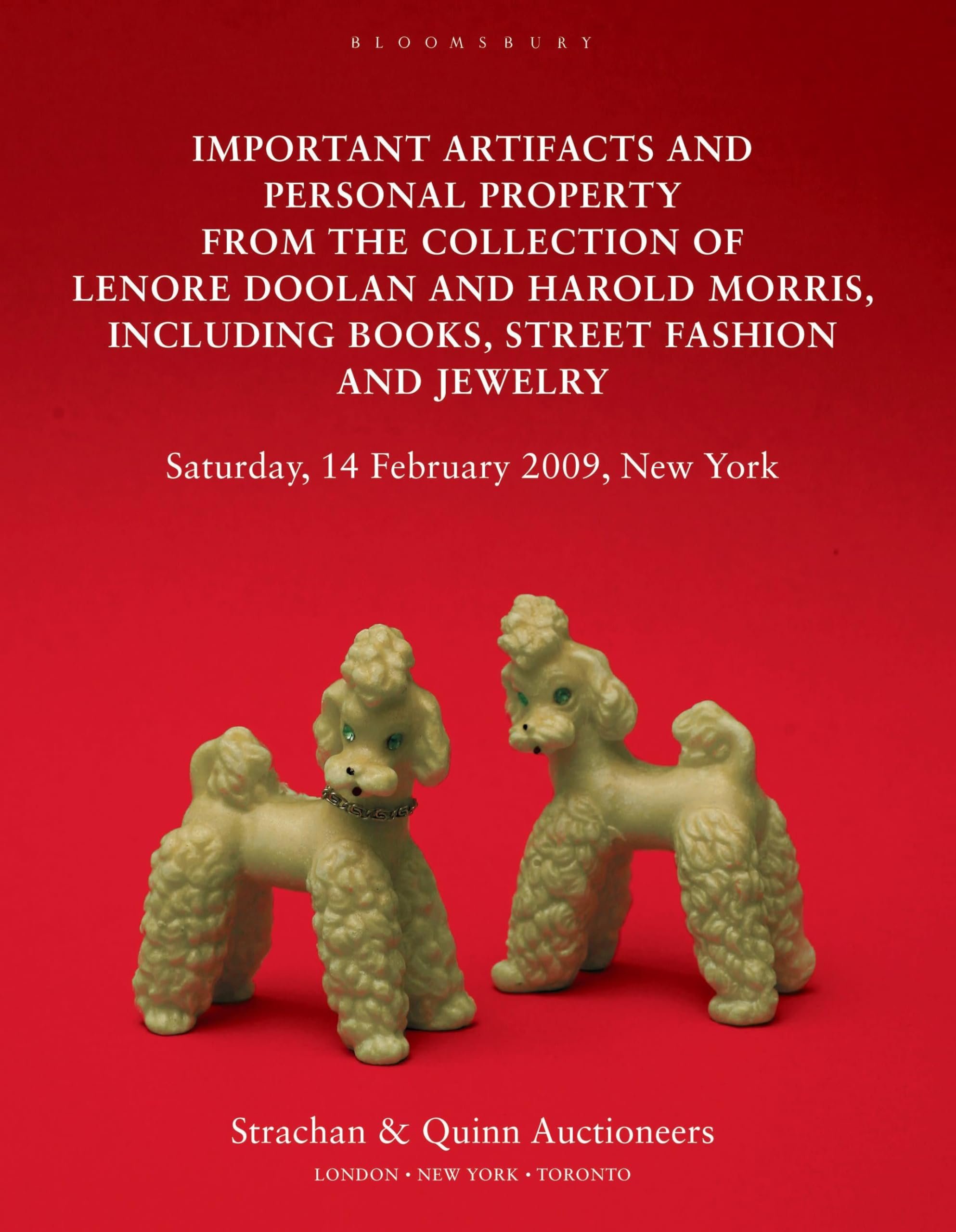
One practitioner who has done just this is the Canadian artist Leanne Shapton, who imagined the dismantling of a fictional relationship between a food writer and a photographer in 325 Lots, published in the auction catalogue Important Artifacts and Personal Property From the Collection of Lenore Doolan and Harold Morris, Including Books, Street Fashion and Jewelry (2009), which you can browse here. The catalogue imaginatively explores the questions: how do we navigate our emotional lives in things? How do they shape the making and breaking of intimate relationships? And how can they speak of love, grief, and the end of romance?
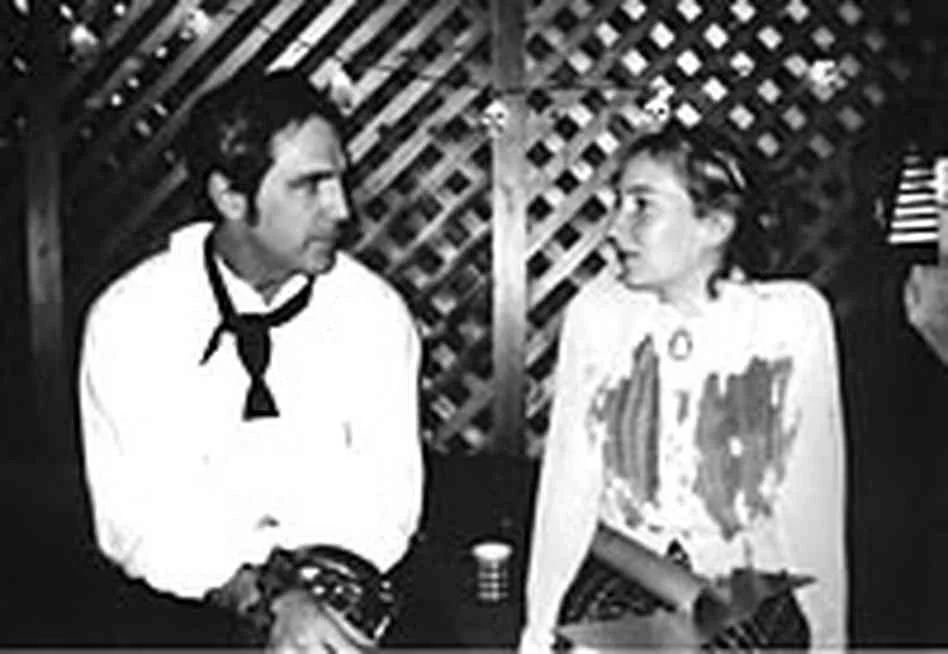
The ‘first known photo’ of the couple at a Halloween party, where he is dressed in chains as Harry Houdini
Shapton’s imagined auction was held in New York on Valentine’s Day 2009, and can be read as a graphic novel telling the story of Lenore Doolan and ‘Hal’ Morris’ relationship from their first meeting at a Halloween party to their eventual separation. The assembled objects situate the couple and their relationship amidst the detritus of everyday life in receipts, post-its, messages scribbled on napkins, newspaper clippings, polaroids, books and bookmarks, toiletry bags, clothing, accessories, and kitchen paraphernalia such as a symbolically broken mug and note from Doolan promising to fix it.
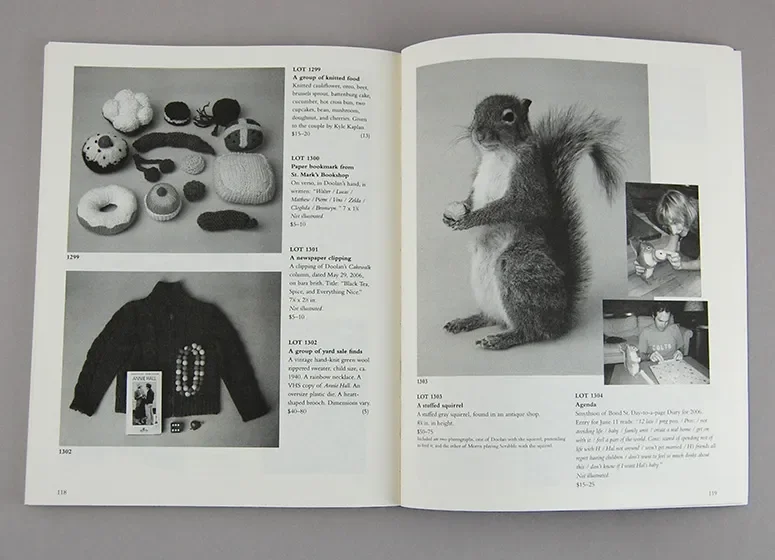
Lots 1299-1304 in Leanne Shapton’s Important Artefacts, pp. 118-19. In addition to the stuffed squirrel are a group of yard sale finds, a newspaper clipping, paper bookmarks, a selection of knitted food, and a diary, with the admission ‘I don’t know if I want Hal’s baby’. Image source: https://clarelmarks.wordpress.com/2015/12/11/important-artifacts-and-personal-property-from-the-collection-of-lenore-doolan-and-harold-morris-including-books-street-fashion-and-jewelry/
We might even view the catalogue as a Cabinet of Curiosity itself, particularly in the taxidermy squirrel that the couple ‘find’ at an antiques store (Lot 1303) during one of their days out together, and are pictured pretending to feed and play Scrabble with, revealing the intimacies and amusements of their private life. Like Shapton’s catalogue, the students’ Cabinets of Heartbreak will launch on Valentine’s Day 2026. Each cabinet will become its own small archive of feeling, helping us to conceptualise how romantic heartbreak is lived and made material.
[1] Francis Bacon, Gesta Grayorum, Or, The History Of The High And Mighty Prince, Henry Prince Of Purpoole, Arch-Duke Of Stapulia And Bernardia, Duke Of High And Nether Holborn, Marquis Of St. Giles And Tottenham, Count Palatine Of Bloomsbury And Clerkenwell, Great Lord Of The Cantons Of Islington, Kentish-Town, Paddington And Knights-Bridge, Knight Of The Most Heroical Order Of The Helmet, And Sovereign Of The Same; Who Reigned And Died, A.D. 1594. Together With A Masque, As It Was Presented (By His Highness's Command) For The Entertainment Of Q. Elizabeth; Who, With The Nobles Of Both Courts, Was Present Thereat.
[2] Freya Gowrley, Fragmentary Forms: A New History of Collage (Princeton and Oxford, 2025), p. 113.
[3] Gowrley, Fragmentary Forms, p. 116.